Burt Hammersmith
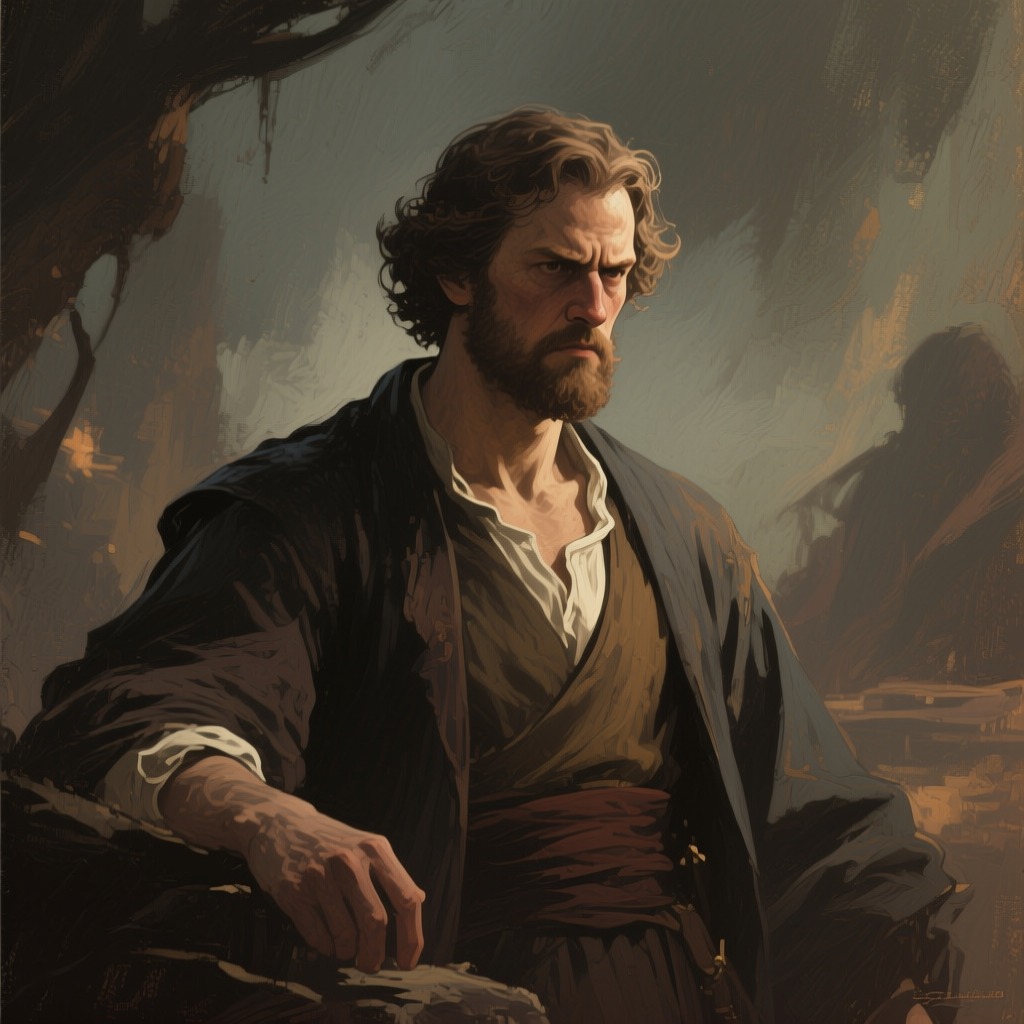
Burt Hammersmith, the sole full-time reporter for the Tefton Intelligencer, wrote most of the newspaper's stories on the John Coffey trial. Paul Edgecombe, the E Block superintendent, sought him out after Coffey's arrival on the Green Mile, driven by a curiosity that went beyond the published accounts. Hammersmith lived with his wife, Cynthia, and their two young children in a small house off a rutted dirt road, and it was there, on his back porch, that he told Edgecombe what the Intelligencer had considered too gruesome to print—the details of the brief manhunt that had netted Coffey, and the condition of the Detterick twins' bodies when they were found. He spoke in a low, unemotional voice, but his eyes never left his own children as they played on a swing at the foot of the yard, a fact that gave his words a terrible weight.
The Reporter's Investigation and His Certainty of Guilt
Hammersmith had tried to trace Coffey's backtrail, a logical step given that a man of Coffey's size and race should have been easy to follow. He came up almost empty: a couple of railroad workers thought they saw him in the Knoxville yards two days before the murders, and a Kentucky man said he had hired a big bald black man to shift crates in the early spring of that year. Beyond that, there was nothing. Hammersmith explained this by pointing to the Depression, which had set people all over the roads, making even a giant like Coffey unremarkable until he killed two little white girls. When Edgecombe pressed him on whether he believed Coffey was guilty, Hammersmith did not answer directly. Instead, he told a story about his own dog, Sir Galahad, a gentle mongrel that had been good with the children until the day it lunged at his son Caleb's face for no apparent reason, nearly killing the boy. Hammersmith shot the dog. He drew a direct parallel: Coffey was like that dog, a creature that might be gentle a thousand times but would bite if the chance came and it crossed his mind. "Oh, yes," he told Edgecombe. "He did it. Don't you doubt it, and don't you turn your back on him."
The Scars and the Parable of the Dog
Hammersmith had seen Coffey's scars, which the defense attorney had displayed to the jury by having Coffey take off his shirt. He noted that the scars were "all broken up" and "latticed," indicating that someone had beaten Coffey severely when he was a child, before he grew. But Hammersmith's conclusion was that the beatings had not managed to "whop the devil out of him." He made a biting gesture with his hand, snapping his fingers against his thumb, to illustrate how Coffey, like the dog, could turn without warning. The parable was driven home by the appearance of his son Caleb, whose face was disfigured by a huge circular scar that ran from his hairline, through a dead eye, and to the corner of his mouth. Hammersmith caressed the boy's bunched cheek with a lover's fingers, a gesture that revealed the depth of his own trauma and the source of his unshakeable conviction.
The Encounter's Effect on Paul Edgecombe
Edgecombe left Hammersmith's house with the reporter's words echoing in his mind, the image of Caleb's ruined face and the memory of the biting hand burned into his consciousness. The drive back to the prison was long and silent; all the songs had gone out of him. Hammersmith had given him no comfort, no alternative theory, only a stark, unforgiving certainty that Coffey was guilty, and a warning that the same capacity for sudden violence lurked in all such men. The encounter hardened Edgecombe's initial doubts into a more complex, troubled awareness, one that would later be challenged by the evidence of Coffey's healing power and the revelation of William Wharton's true role in the murders.